

Rigdzin Legden Dorje
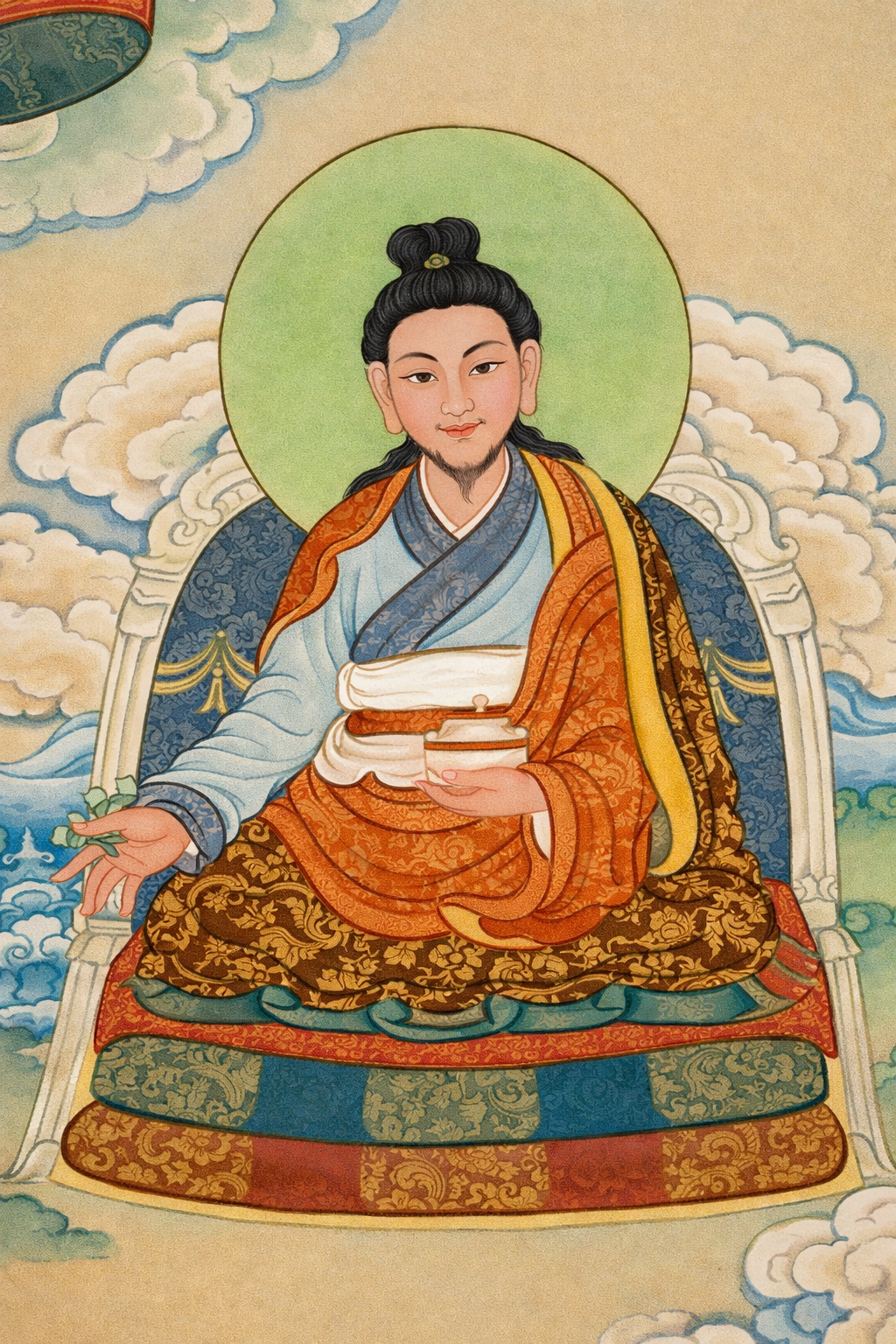
The Second Dorje Drak Rigdzin: Lekden Dorje
The Second Dorje Drak Rigdzin, Lekden Dorje (Las ldan rdo rje), was born at Lhundrup Choding in the region of Ngari, in the kingdom of Lowo (Lo Manthang), around 1488–1489. Some traditional biographies, however, place his birth in 1452, based on the belief that he passed away in 1565 at the age of one hundred and thirteen. Although modern scholars generally regard the later birth date as more historically plausible, both dates continue to appear in Tibetan sources.
His family traced its ancestry to the ancient royal lineage of Tibet. His father, Jamyang Rinchen Gyeltsen, was a renowned tantric practitioner who was regarded by some as an incarnation of the great translator Marpa Lotsawa. According to traditional accounts, he fathered eight sons. Five were believed to embody the wisdom of the Five Buddha Families, while another was considered an emanation of the protector Gonpo Lekden. Among all the brothers, only Lekden Dorje and his elder brother, Ngari Panchen Pema Wangyal, would become widely celebrated as important masters of the Nyingma tradition.
From an early age, Lekden Dorje displayed exceptional intelligence. At the age of seven he learned to read and write under the guidance of his mother, who frequently encouraged him to pursue the contemplative life. She believed that while carrying him she had received the blessings of Guru Padmasambhava, convincing her that her son was destined for an extraordinary spiritual career. He was later ordained by his father, who shaved his head and bestowed upon him the name Nyida Drakzang. The name Lekden Dorje is traditionally said to have originated in a prophecy of the tertön Kunkyong Lingpa. Because his father showed him unusual affection and indulged him during childhood, the young boy became playful and mischievous, earning the humorous nickname "Lekden the Mischievous Spirit" among local villagers.
A profound turning point came after the death of a beloved aunt. Confronted with the reality of impermanence, he abandoned his carefree youth and devoted himself wholeheartedly to Dharma practice. Under his father's guidance at Lhundrup Choding Monastery, he received extensive instruction in tantric ritual, empowerments, oral transmissions, and the commentarial traditions associated with the Sixty-five Maṇḍalas of the Dowang cycle, together with detailed study of the Guhyagarbha Tantra, the central scripture of the Nyingma Mahāyoga tradition. After several years of intensive study, his father entrusted him with helping care for his elder brother, whose own scholarly activities required considerable support.
Rather than remaining at home, Lekden Dorje chose the life of an itinerant seeker of knowledge. He travelled throughout Ü and Tsang, studying with more than one hundred teachers belonging to both the Nyingma and Sarma traditions. His journeys brought him to many of Tibet's most revered pilgrimage sites, including the sacred image of Buddha Śākyamuni at Kyirong, where he made offerings before continuing his search for accomplished masters and authentic transmissions.
During one of these journeys through the Neshang region he contracted smallpox. Traditional biographies recount that he overcame the illness through meditative accomplishment and tantric practice rather than ordinary medicine, a story frequently cited as an early sign of his spiritual attainments.
Among the many masters from whom he studied was Namkha Sherab, from whom he received the Khandro Nyingtikand the Six Yogas of Niguma. Returning to Lowo, he continued his education under both his father and his elder brother. Ngari Panchen bestowed upon him numerous empowerments and instructions, including practices of Four-Armed Avalokiteśvara, Heruka, and various treasure teachings, while his father transmitted further cycles of Mahāyoga tantra, including the Scripture of the Great Assembly (Sangwa Düpa).
The two brothers later undertook a pilgrimage to Samye Monastery, Tibet's first Buddhist monastery. Remaining there for seven days, they performed extensive rituals to renew the sacred power of the site and established a small community of tantric practitioners known as Evam Chökgar, reflecting their shared commitment to preserving the contemplative traditions of the Ancient School.
Their travels eventually led them into Nepal, where they visited numerous sacred places associated with Padmasambhava. At Yangléshö, one of the most revered meditation caves near Kathmandu, Lekden Dorje met Shakya Zangpo, later recognized as the First Yolmo Tulku and one of the foremost disciples of Rigdzin Gödem, the great revealer of the Northern Treasures (Jangter) tradition. Recognizing Lekden Dorje as the spiritual continuation and incarnation of Rigdzin Gödem, Shakya Zangpo bestowed upon him the complete empowerments, transmissions, and pith instructions of the Jangter lineage. The two then entered a year-long retreat together at Riwo Pelbar, during which Lekden Dorje received the complete transmission of Gödem's treasure cycle and became its principal heir.
This meeting marked a decisive turning point in his life. Although he had already received an exceptionally broad education from masters representing numerous Tibetan Buddhist traditions, it was through Shakya Zangpo that he formally inherited the complete spiritual legacy of Rigdzin Gödem. Later generations would therefore regard Lekden Dorje not merely as Gödem's reincarnation but as the principal figure responsible for consolidating and transmitting the Northern Treasures tradition after its founder's passing.
Upon returning home he learned that his mother had died. Together with his brother he conducted elaborate funeral ceremonies, sponsored offerings to monasteries and teachers, and distributed alms to the poor. After serving his father for another year, he entered a solitary retreat at Tangkya Cave, remaining there for an entire year before accompanying his brother to Dolpo, where he received additional teachings on the Vajramālā, Lamdré, Nāro Khechari, and other advanced tantric systems.
During this period he also began compiling and editing collections of tantric instructions concerning the graduated stages of Vajrayāna practice. These works became the basis of many of his later teachings, in which he frequently illustrated profound doctrinal points by quoting verses from the songs of Jetsün Milarepa. He continued serving Shakya Zangpo as ritual assistant and attendant whenever circumstances required, while also receiving supplementary transmissions preserved by disciples of his previous incarnation, particularly teachings connected with the Riwo Trazang treasure cycle.
Having completed these studies, Lekden Dorje withdrew into prolonged retreat at Riwo Pelbar, where he devoted himself to uninterrupted meditation for approximately ten years. This period of intensive practice profoundly shaped his later career. After emerging from retreat, he once again travelled extensively through Central Tibet with his brother, visiting Lhasa, numerous monasteries, and many of the foremost religious teachers of the age to deepen and broaden his realization.
While practicing in a cave near Samye, Lekden Dorje began to receive visionary revelations indicating the locations of concealed treasures. Guided by protective deities, he discovered his first treasure texts at Drakmar Drinzang, where two sacred scrolls were revealed. Further revelations followed at Wonpu Tashi Chobuk, where he bestowed teachings on the Dzogchen cycle Kunzang Gongpa Zangthal, while accounts also credit him with performing rituals that brought rain during periods of drought.
One of his most celebrated discoveries occurred at Taktsang, where he uncovered an ancient meditation cave believed to preserve the throne of Padmasambhava together with numerous sacred objects. There he revealed several important treasure cycles, including practices centered upon Guru Drakpo and Hayagrīva. Traditional biographies describe miraculous signs accompanying these revelations, including naturally formed sacred images and footprints impressed in stone.
Following these discoveries, Lekden Dorje undertook another period of rigorous retreat near Samye, surviving almost entirely on nettle soup in imitation of Milarepa's ascetic discipline. Emerging from retreat, he travelled widely throughout Tibet, conferring empowerments, transmitting Dzogchen teachings, revealing additional treasures, and strengthening the growing network of disciples devoted to the Northern Treasures tradition.
His reputation spread throughout Tibet, and he was invited to teach at influential monasteries including Drigung and Tsurphu, where he instructed both Nyingma and Kagyu practitioners. He also returned repeatedly to Nepal, revisiting sites associated with Rigdzin Gödem and restoring sacred places connected with earlier treasure revelations.
During his journeys through Sikkim, he consecrated sacred locations associated with Guru Padmasambhava and contributed significantly to establishing the region as an important center of Nyingma practice. In later years he spent considerable time teaching in the regions of Chuwori and Won, where many of his principal disciples gathered around him. His spiritual consort, Nyemo Cham Khyentsema, bore a son who was later regarded as an emanation of the great siddha Tangtong Gyalpo.
Although celebrated primarily as the principal holder of the Northern Treasures lineage, Lekden Dorje maintained an unusually broad approach to Buddhist learning. Throughout his life he continued receiving and practicing both Ancient and New Translation traditions, including the tantras of Cakrasaṃvara, Guhyasamāja, and Yamāntaka. Tibetan biographies consistently portray him as a master whose profound meditative realization was accompanied by extraordinary siddhis, including mastery over the elemental forces of nature and the ability to subdue obstructing spirits. His accomplishments were praised by later generations, including the Fifth Dalai Lama, who acknowledged his exceptional realization and his enduring contribution to the transmission of the Nyingma teachings.
In his later years, Lekden Dorje entrusted the future of the lineage to his disciple Tashi Tobgyal, whom he recognized as the reincarnation of his own elder brother, Ngari Panchen Pema Wangyal. Before his passing, he bestowed upon him the essential empowerments, oral transmissions, and prophetic instructions necessary to continue the lineage.
Traditional sources record that Lekden Dorje passed away in 1565. Some accounts attribute his death to the effects of black magic employed by jealous rivals, although such narratives belong to the hagiographical tradition and cannot be historically verified. His body was cremated at Chuwori, where a reliquary stūpa was erected in his memory. Before passing into parinirvāṇa, he is said to have foretold that he would be reborn as the son of his devoted disciple Tashi Tobgyal, thereby ensuring the continuation of the lineage.
The institution that he established eventually developed into Dorje Drak Monastery, which became one of the Six Mother Monasteries of the Nyingma school and the principal seat of the Northern Treasures (Jangter) tradition. Together with Rigdzin Gödem, Lekden Dorje is revered as one of the founding Dorje Drak Rigdzins. If Rigdzin Gödem revealed and established the Northern Treasures, it was Lekden Dorje who consolidated, expanded, and secured their transmission, laying the institutional and spiritual foundations upon which the Dorje Drak lineage would flourish for centuries.