

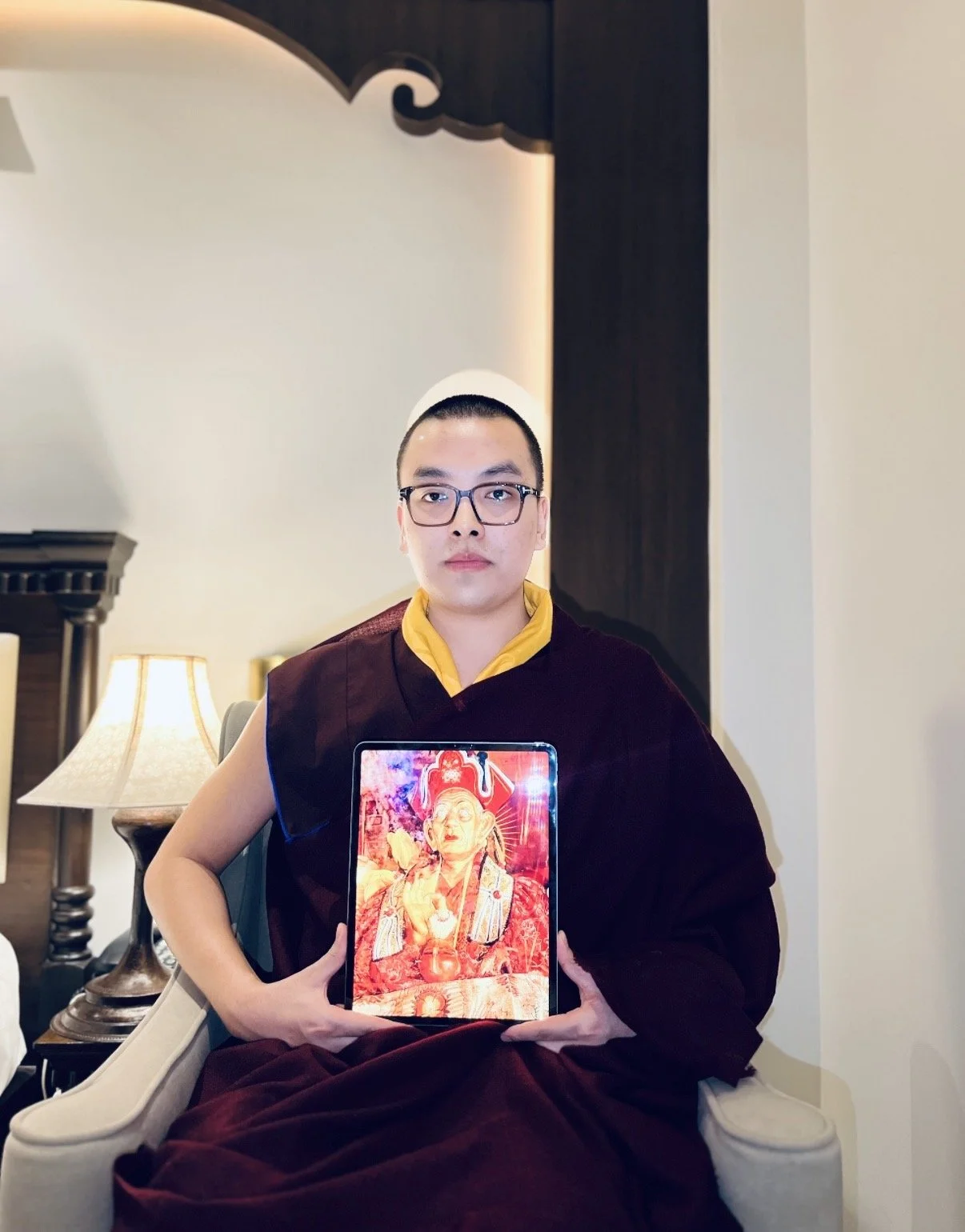
The present Dordrak Gyalsay Rinpoche, Shedrup Gyaltshen Pal Zangpo, was born on the 10th June 2000 ( the eighth day of the fourth month of the Tibetan lunar calendar in the Iron Dragon year), in Bumthang, Bhutan. He was born into a family belonging to the Northern Treasure (Byang gter) lineage. His paternal ancestry is rooted in the Nyingma tradition of Vajrayana Buddhism, and he is the grand-nephew of His Holiness Taklung Tsetrul Rinpoche, the sixth Supreme Head of the Nyingma School of Tibetan Buddhism.
The place of his birth is regarded as a site of profound religious importance, closely associated with the great tertön Pema Lingpa and the eminent scholar Longchen Rabjam (Longchenpa). Within his Tibetan family lineage, ancestral traditions also preserve sacred narratives connected with ancient protector deities believed to have journeyed from India to Tibet in early times. According to these accounts, a deity in the form of a vulture once carried a companion across the mountains to the region of Samye Monastery. There, a solemn vow was made to safeguard that individual’s lineage, symbolically linking the family’s spiritual heritage with the protection and continuity of the Dharma. Such accounts continue to be remembered as part of the living cultural and religious memory of the lineage.
Dordrak Gyalsay Rinpoche was recognized in early childhood as the sixth reincarnation in this lineage. His recognition was formally conferred by the Tibetan lama Drubwang Thupten Nyima Rinpoche. In his later teenage years it was reaffirmed by Sakya Gongma, the most senior master of the Sakya tradition, and subsequently confirmed by the Tenth Dordrak Rigdzin Chenpo, the principal throne holder of the Northern Treasures lineage. These recognitions reflected a convergence of acknowledgement across different Tibetan Buddhist traditions.
He began his monastic education at Dorjidrak Monastery in Shimla, India at the age of 9, established under the guidance of his grandfather, Taklung Tsetrul Rinpoche. There he undertook the traditional monastic curriculum at the shedra, engaging in systematic study of Buddhist philosophy over more than a decade. His training included logic and debate, Madhyamaka